
Shreya Jha smiling at the edge of a canyon

Ph.D. Student · Computer Science

Shreya Jha

Courant Institute of Mathematical Sciences, New York University

I'm a second-year Ph.D. student in Computer Science at NYU's Courant Institute, advised by Benjamin Peherstorfer. My research sits at the intersection of scientific computing and machine learning, focused on fast and reliable simulation of stochastic and nonlinear dynamical systems. Before NYU, I studied mathematics and computer science at Georgia Tech, where I was advised by Florian Schaefer. My work is supported by an NSF Graduate Research Fellowship.

News

Publications

* denotes equal contribution. See also Google Scholar.

  1. NeurIPS 2026

    First-Order Trajectory Matching: Fast Ensemble Predictions of Chaotic, Turbulent, Stochastic Systems

    S. Jha, T. Schorlepp, N. Geissler, J. Berman, B. Peherstorfer

  2. Preprint

    One-Step Generative Surrogate Models via Block-Triangular Joint Drifting

    N. Geissler, S. Jha, R. Baptista, B. Peherstorfer

  3. Workshop

    Solver to System: LLM Reasoning Across Representations and Execution in Scientific Simulation

    E. Berman*, R. Subramanian*, S. Jha, L. Jagarapu, R. Ranganath

Projects

NYU Courant

First-Order Trajectory Matching

Predicting chaotic and turbulent systems means running large ensembles, and each simulation is expensive. FTM learns a generative surrogate straight from trajectory data that advances the whole ensemble with a single network evaluation per time step. On 2D turbulence, it is both faster and more accurate than diffusion-based surrogates.
NYU Courant

Solver2System

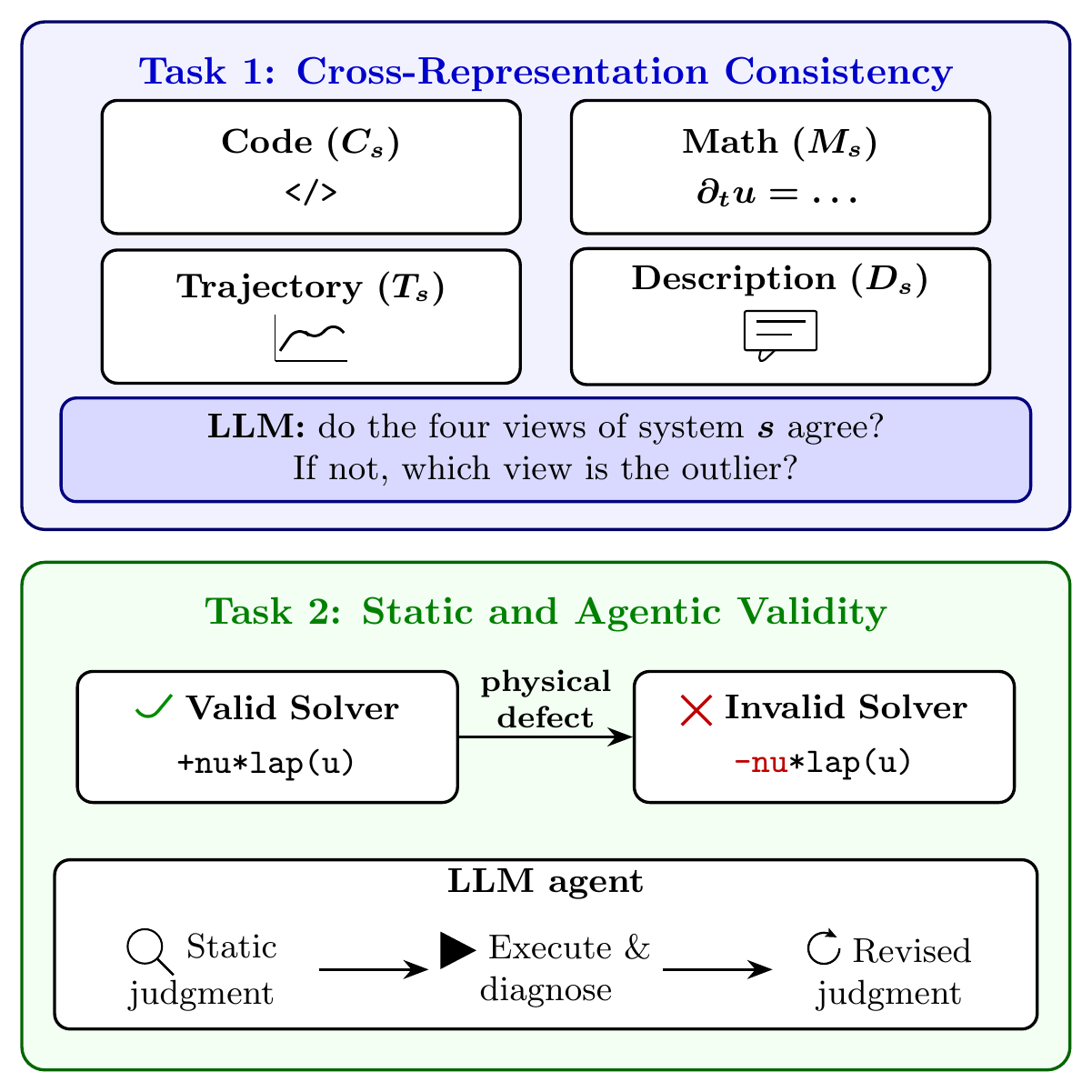
Solver2System tests whether LLMs can recognize when scientific simulation code is physically wrong. It pairs 32 PDE solvers with their equations, trajectories, and plain-language descriptions, along with versions containing planted physical bugs. We use it to evaluate whether models can catch and diagnose these errors, both by reading the code and by running it.

Georgia Tech

Stable High-Order Moment Closures

Moment closures approximate a stochastic system by tracking just a few of its statistics, but higher-order closures tend to blow up. I developed stabilization techniques, based on semidefinite programming and damping of higher-order cumulants, that keep closures stable up to 12th order and track reference solutions better than the standard Gaussian closure.